EazLink guide
What is BIR EIS integration middleware?
A direct explanation of the software layer between an existing ERP, POS or CAS and Philippine BIR EIS workflows.
Updated 2026-09-06 by the EazLink team. Editorial review: EazLink Editorial Team.
Direct answer
BIR EIS integration middleware receives invoice data from the system that already runs the business, checks and maps that data, manages transmission, and returns a usable status. It does not replace the ERP, POS, CAS or ecommerce platform. It keeps BIR-specific logic out of those core systems.
What to remember
- Middleware is the connection layer, not a new accounting package.
- The source system should remain the owner of the commercial transaction.
- A useful integration returns accepted, rejected, queued and retrying states.
- The taxpayer still needs to confirm its legal scope and complete the applicable BIR process.
Middleware, portal and ERP in brief
The three tools solve different parts of the job.
| Option | What it does | Best fit |
|---|---|---|
| ERP, POS or CAS | Creates the sale and accounting record | Daily business operations |
| BIR portal | Provides official taxpayer and certification workflows | Registration, reference and manual tasks |
| Integration middleware | Maps, validates, transmits and tracks invoice data | Automated system-to-system work |
The current BIR procedure decides which portal and certification steps apply.
Where middleware sits
The ERP or POS sends one well-defined transaction to the middleware. The middleware translates it into the configured BIR EIS format, records the response and returns that result to the source system.
This boundary matters because tax rules and government interfaces change on a different schedule from sales and accounting software.
What the integration must record
A transaction needs a stable source reference, taxpayer and branch identity, invoice lines, taxes, totals and lifecycle event. The response record needs the submission time, result, error detail and final proof.
Developer logs are not enough. Finance and support teams need a status they can read and reconcile.
Where EazLink fits
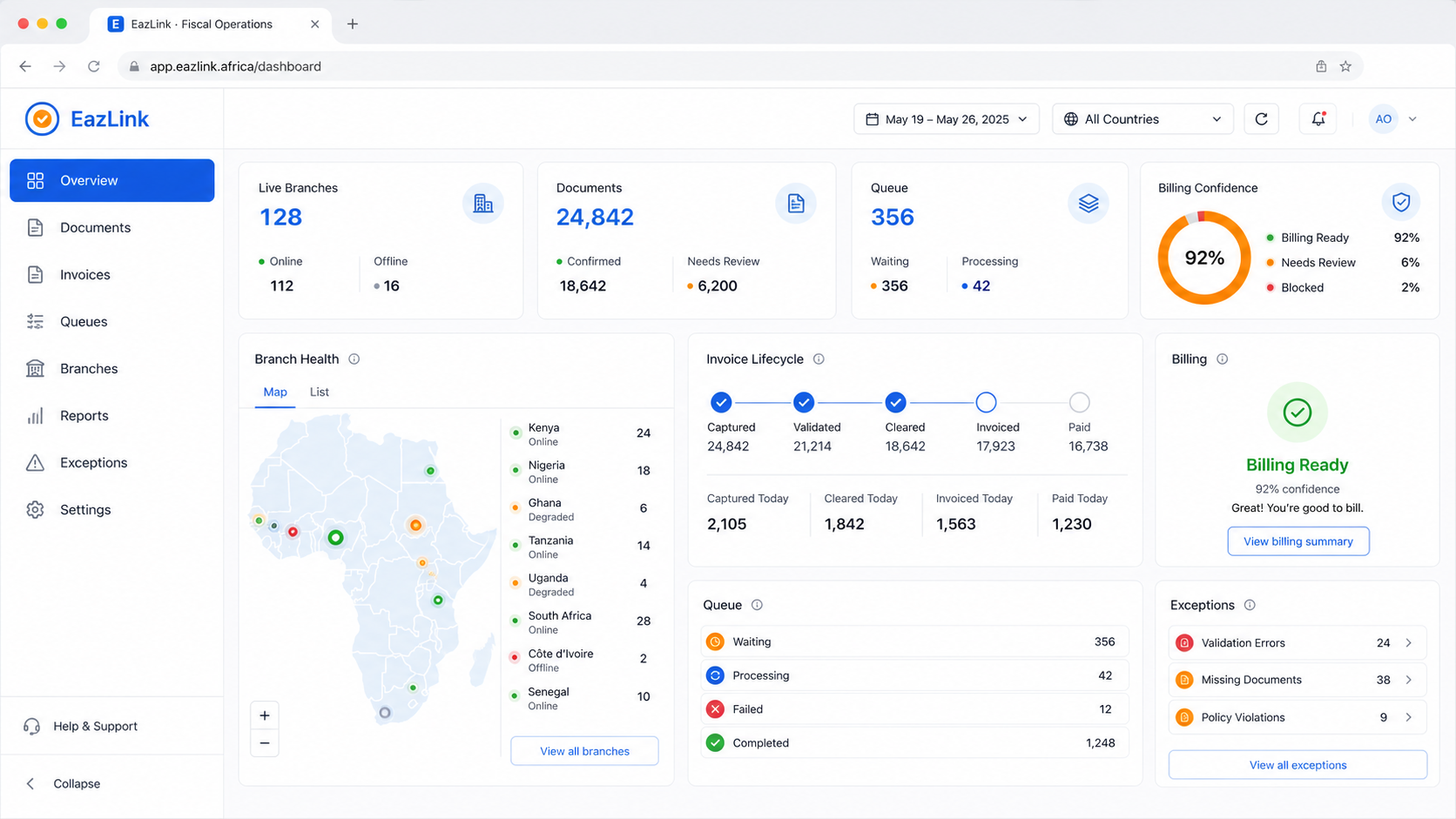
EazLink provides the middleware layer around existing business systems. It supports data mapping, validation, status tracking, controlled retries and evidence without presenting itself as an accounting product.
EazLink supports readiness work. It does not claim automatic BIR approval or replace advice from the BIR or a qualified Philippine tax adviser.
Questions to answer before selecting middleware
- Which system creates the official invoice record?
- Which entity and branch issued it?
- What response must return to the source system?
- How are timeouts and duplicates handled?
- Who reviews exceptions each day?
Quick questions
Does middleware replace a CAS?
No. A CAS handles accounting records and may create invoices. Middleware handles the connection and operating controls around the BIR EIS workflow.
Can one middleware connect several systems?
Yes, if each source has a defined adapter and all transactions enter a common validation and status model.
Is EazLink BIR accredited?
EazLink does not make that claim. Certification and permission depend on the taxpayer, system, current BIR requirements and the official process.
Continue the preparation
Sources and verification
Check the current BIR rules and portal notices before making a compliance decision.